



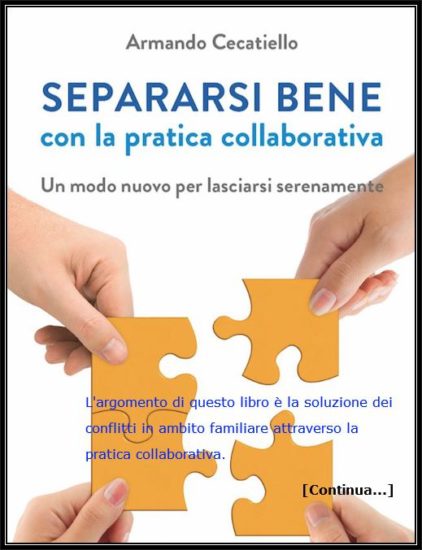
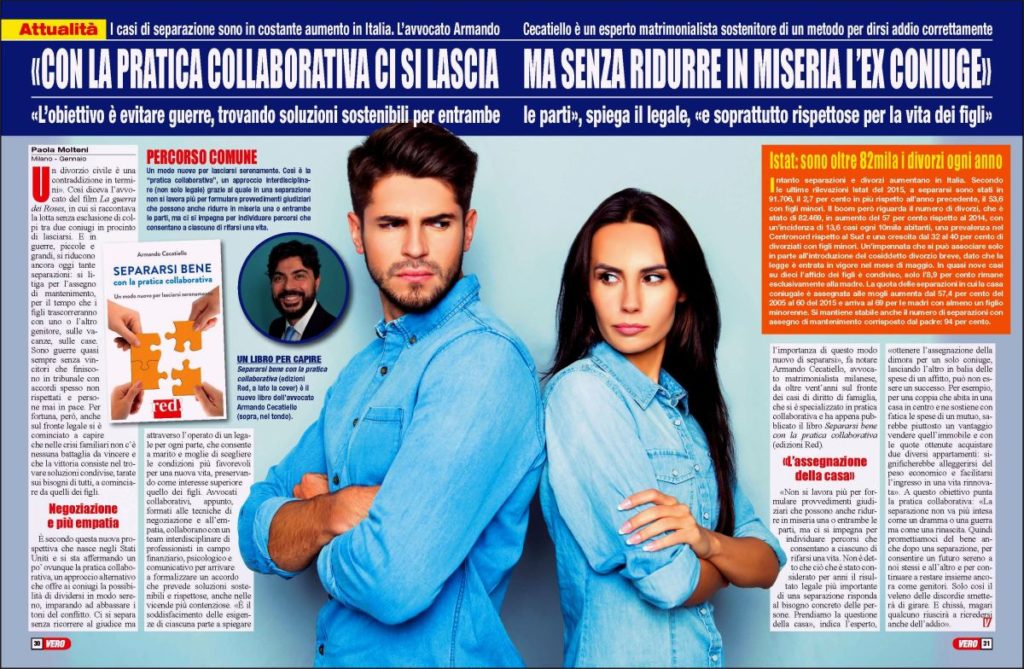
We report the article by Paola Molteni published in the weekly Vero regarding the publication of the lawyer Cecatiello's book entitled “Separating well with collaborative practice”. (January 2018).
The cases of separation are constantly increasing in Italy. The lawyer Armando Cecatiello is an experienced matrimonialist who advocates a method to say goodbye correctly: "with the collaborative practice one leaves oneself without reducing the former spouse to poverty"; "The goal is to avoid wars, finding sustainable solutions for both parties", explains the lawyer, "and above all respectful for the lives of children".
Istat: there are more than 82 thousand divorces every year.
Meanwhile, separations and divorces are increasing in Italy. According to the latest Istat surveys of 2015, 91.706 people separated, 2,7 percent more than the previous year, 53,6 with minor children. The boom, however, concerns the number of divorces, which was 82.469, an increase of 57 percent compared to 2014, with an incidence of 13,6 cases per 10 inhabitants, a prevalence in the Central North compared to the South and an increase from 32 40 per cent of divorcees with minor children. A surge that can only be partially associated with the introduction of the so-called short divorce, given that the law entered into force in May. In almost nine out of ten cases, custody of the children is shared, only 8,9 percent remains exclusively with the mother. The share of separations in which the marital home is assigned to wives increases from 57,4 percent in 2005 to 60 in 2015 and reaches 69 for mothers with at least one minor child. The number of separations with maintenance allowance paid by the father also remained stable: 94 per cent.
"A civil divorce is a contradiction in terms ." So said the lawyer in the film "The War of the Roses," which chronicled the no-holds-barred battle between two spouses about to separate. And many separations still end up in wars, both large and small: arguments over child support, the amount of time the children will spend with one parent or the other, vacations, and homes. These are almost always unwinnable wars, ending in court with agreements often broken and people never at peace. Fortunately, however, even on the legal front, people have begun to understand that in family crises, there is no battle to win and that victory lies in finding shared solutions, tailored to everyone's needs, starting with those of the children.
Negotiation and more empathy
It is in accordance with this new perspective that collaborative law was born in the United States and is gaining popularity everywhere. This alternative approach offers spouses the opportunity to separate peacefully, learning to tone down conflict. Separation is achieved without resorting to a judge, but through the work of a lawyer for each party, allowing husband and wife to choose the most favorable conditions for a new life, preserving the best interests of their children. Collaborative lawyers, trained in negotiation techniques and empathy, work with an interdisciplinary team of financial, psychological, and communications professionals to formalize an agreement that provides sustainable and respectful solutions, even in the most contentious situations. "Satisfying the needs of each party explains the importance of this new way of separating," notes Armando Cecatiello, a Milanese matrimonial lawyer with over twenty years of experience in family law, who specializes in collaborative law and has recently published the book Separarsi bene con la pratica collaborativa (Separarsi bene con la pratica collaborativa, published by Red).
The assignment of the house
“We no longer work to formulate judicial measures that can also reduce one or both parties to misery, but we are committed to identifying paths that allow each to rebuild a life. What has been considered for years the most important legal result of a separation does not necessarily respond to people's concrete needs. Let's take the question of the house ", indicates the expert," obtaining the assignment of the dwelling for only one spouse, leaving the other at the mercy of the costs of a rent, may not be a success. For example, for a couple who lives in a house in the center and hardly bears the costs of a mortgage, it would rather be an advantage to sell that property and buy two different apartments with the shares obtained: it would mean lightening the economic burden and facilitating the 'entry into a renewed life ». Collaborative practice aims at this goal: «Separation should no longer be understood as a drama or a war but as a rebirth. So let's promise each other good even after a separation, to allow a peaceful future for ourselves and the other and to continue to be together again as parents. Only in this way will the poison of discord stop spinning. And who knows, maybe someone will even be able to change his mind about the farewell ».
Common path
A new way to leave oneself peacefully. This is the "collaborative practice", an interdisciplinary approach (not only legal) through which in a separation no longer works to formulate judicial measures that can even reduce one or both sides to poverty, but we commit ourselves to identify paths that allow each one to rebuild their lives.
A book to understand, “Separating well with collaborative practice” (editions
Red, beside the cover) is the new book by the lawyer Armando Cecatiello.
EdizioniVero : "Vero is a family weekly aimed at a broad and diverse audience, with a distinctive editorial and graphic quality that sets it apart and makes it a standout in its segment. It establishes a direct link to the world of entertainment, while also keeping a close eye on current affairs, politics, culture, and fashion and beauty trends. It also covers health, cooking, and savings, and offers numerous columns written by well-known faces, professionals, doctors, and lawyers."
Cecatiello Law Firm, Milan. Matrimonial and divorce lawyer specializing in family law, children's rights, and juvenile criminal law. Contact us.